Stump & root excavation near me
Root Removal & Excavation in Shelby, NC
The entire root ball comes out of the ground — for driveways, concrete slabs, patios, and anything else that has to hold up in Cleveland County red clay.
Why grinding isn't enough when you're pouring concrete
Standard stump grinding is the right answer for most yards. But if a driveway is going over that spot, a slab, a patio, a carport, or a new build — grinding leaves too much behind. Grinding cuts the stump 4–6 inches below grade and turns the visible part into chips, but the root ball and the big structural roots under it are still in the ground. Buried under a few inches of topsoil, they look gone. Under a concrete slab, they are a problem waiting to show up.
Those roots are still solid wood, and they're still going to change. As they decay, the ground around and under them settles. In a lawn that shows up as a soft dip. Under concrete it shows up as a crack, a drooping corner, or a slab that breaks apart from the bottom up. We've seen driveways in Shelby and Kings Mountain fail over an old oak root ball that nobody remembered was there.
Shelby's red clay makes it worse
Cleveland County's soil is heavy red clay, and that changes the math. Clay drains slowly and expands and contracts more than sandy soils when it gets wet and dries out again. When a big root in that clay finally rots out, the material around it has nowhere to go and the cavity stays soft and wet. Water collects and sits in the pocket instead of draining away. Concrete needs to sit on solid, evenly compacted ground. A decaying root pocket under a slab gives you exactly the opposite: a hollow the slab bridges over, and a built-in place for water to gather and freeze and work the slab apart.
That's why our rule in this county is simple: if concrete is going on top, the root ball has to come out. Not ground down, not burned, not covered with extra base material — removed, with the hole filled and compacted so the slab has something solid to sit on. Anything less is a gamble on how the old stump rots, and it's your driveway or your floor that loses that bet.
Full root excavation vs. standard grinding
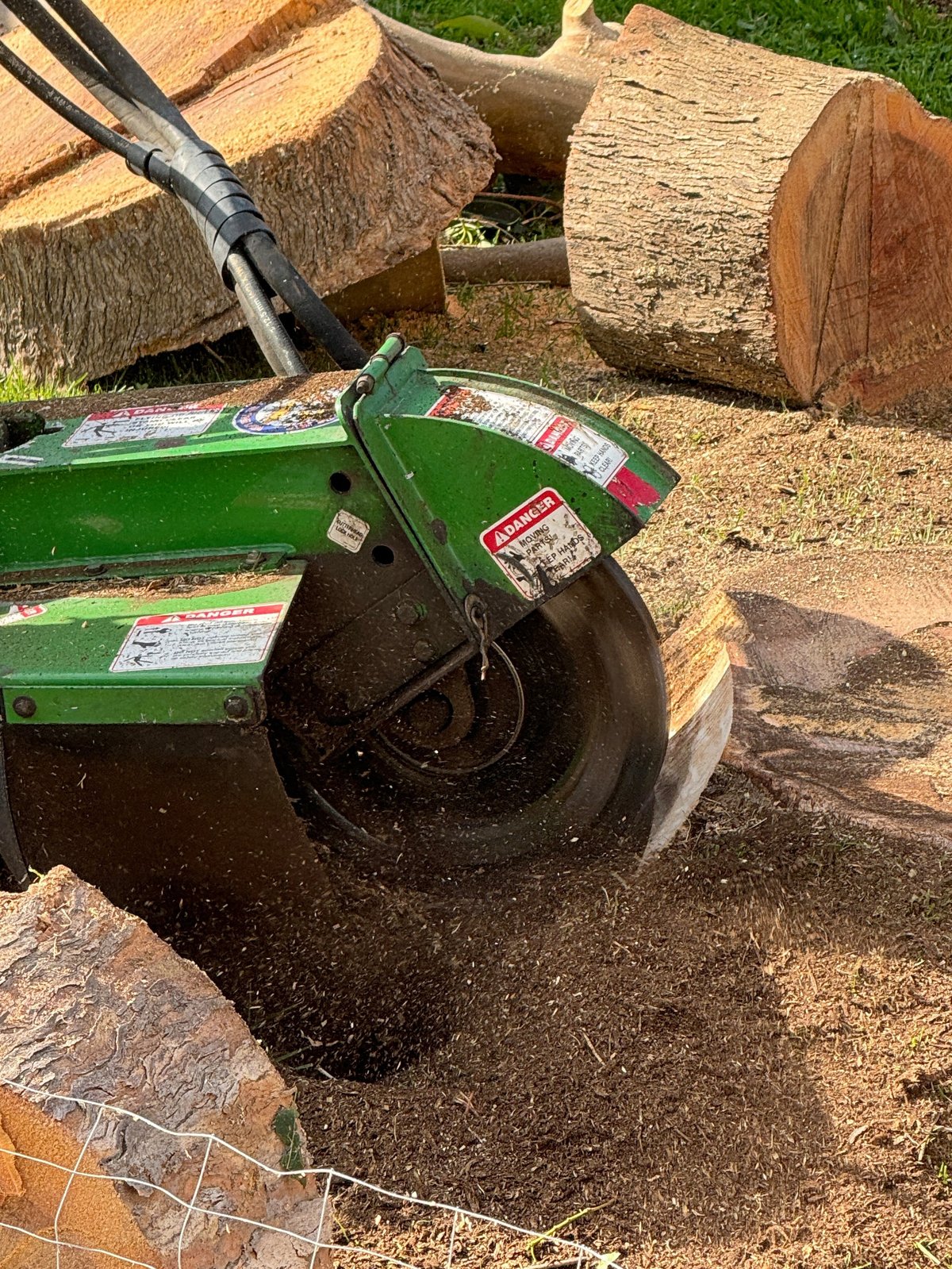
Full root removal — also called stump excavation — goes after the whole structure. We cut away the stump flush with the ground, then excavate around the base to expose the root flare and the large anchor roots. The root ball comes out of the ground, along with the major roots that run outward, and we backfill and compact the hole. On a big hardwood, this is a real excavation job, not a quick pass with a grinder — and it takes machinery, time, and haul-away for the material. That's why it costs more than grinding. It's also exactly what you need whenever the grade above it is going to be permanent.
If you're not sure which one your project needs, tell us what you're planning and we'll say straight out. For a lawn, a flower bed, or a fence post line, standard grinding is usually it. For concrete, structure, or re-grading the site, you're in root removal territory.
Rule of thumb: if the spot is going under concrete, asphalt, a building, or a new grade, get the roots out. A few hundred dollars of excavation now beats a cracked driveway that has to be torn out and poured again.
Have a project starting? Call (980) 737-7498 or use the form on this page and we'll give you a free estimate on the root removal you need.
How we do it
The excavation process, start to finish
Root removal is a bigger job than grinding, and it's done in a careful order so the site is ready for whatever's going on top of it.
- 01
Walk the site and mark utilities
Before anything moves, we look at the stump, the surrounding grade, and anything buried nearby — water, septic, electrical, irrigation. We never excavate blind over a utility line.
- 02
Cut the stump at grade
The stump is cut flush with the ground so we can see the root flare and the structure we're working around — and so nothing is left sticking up.
- 03
Expose the root ball
We dig around the base to expose the root flare and the major anchor roots. On a large oak or hickory, that means finding roots that run well past the stump itself.
- 04
Rip out the root ball
The root ball and its main structural roots come out of the ground. This is the part grinding never reaches, and it's the reason the job is worth doing before concrete goes down.
- 05
Haul off the material
Roots, soil, and stump material are loaded and hauled away, or staged where your site plan asks for them. No pile of rotting roots left under your new slab site.
- 06
Backfill and compact
The hole is filled and compacted with clean material so the grade is solid and ready for your concrete, footings, or landscaping base.
Safety on an excavation job
Root excavation moves heavy material in a tight workspace. We keep the area clear of people and pets, mark and protect utility runs before digging, keep machinery clear of fences and structures, and protect the ground we aren't working on. If the stump is close to a house, fence, or driveway edge, we tell you how we'll work around it before we start.
Working with your builder
If a contractor is pouring the concrete, we can work to their schedule so the stumps and roots are out and the ground is ready before the crew arrives. Tell us the timeline and we'll line up. Building on a lot with several stumps? We'll quote it as a lot clearing job so everything comes out in one pass.
Choosing the right job
Grinding or full root removal? Here's the difference
Standard grinding
- Stump cut 4–6 inches below grade
- Root ball and main roots stay in the ground
- Chips stay on site — cheaper and faster
- Great for lawns, beds, and fence lines
- Not for spots going under concrete
Full root removal
- Entire root ball and major roots excavated
- Hole backfilled and compacted to a solid grade
- Debris hauled off site
- Built for driveways, slabs, and foundations
- Costs more — and saves the cost of a failed slab
What full root removal costs
Full excavation is priced differently from grinding because it's a different job — more machine time, more material to move, and haul-off at the end. The price depends on the size of the root ball, the species, how deep the roots run in the clay, and how much room there is to work.
Because the range is wide, we don't quote it blind over the phone. We look at the stump — often from a photo and a short conversation — and give you a straight number before anything is scheduled. No hourly meter and no surprise add-ons once we're on site.
If there are several stumps on the lot, or a full row needs to go before concrete, the per-stump price comes down. Tell us the full scope and we'll quote it together.
Ready for a number? Call (980) 737-7498 or send the form below.
Serving all of Cleveland County
Homeowners, builders, and contractors across Shelby, Kings Mountain, Lawndale, Fallston, Polkville, Waco, Grover, Casar, Boiling Springs, and Lattimore.
Call (980) 737-7498Free estimate. No obligation.
Common questions
Root removal FAQs
Can I just grind the stump and pour over it?
We don't recommend it in Cleveland County. In red clay, the rotting root ball leaves a soft, water-collecting pocket under the slab. That's how driveways crack and settle. If concrete is going down, we remove the root ball and backfill it properly.
How much of the roots do you remove?
The root ball and the major anchor roots come out. Very fine roots spread far into the clay, but they don't cause the settlement that large roots do. Exposing and removing the structural roots is what makes the grade reliable.
How big is the hole?
It depends on the stump and root spread — bigger stumps mean a bigger excavation. We backfill and compact when we're done, so you're left with a solid, level grade rather than an open pit.
Will this damage my driveway or lawn?
Excavation involves machinery, so we plan access to keep damage to a minimum. If a truck or machine has to cross a driveway or lawn, we'll tell you in advance what to expect. Small marks in the yard from access are normal on an excavation job.
Does my contractor need this done first?
Usually yes. Most concrete crews want the stump and roots gone and the ground compacted before they form and pour. We can work to your builder's schedule so everything's ready when they are.
Do you handle storm-damaged root balls?
Yes. Uprooted trees after summer and fall storms often leave a root ball that needs excavation rather than grinding. See our storm cleanup service or call and tell us what you're looking at.
Free estimate
Get a quote on root removal
Tell us what you're building and where the stump is, and we'll come back with a straight price for getting the roots out.